Bellagio upgrades approved with immersive visualization support.
← All stories
Expanding the Language
Case Studies / 03 · WET
Expanding the Language
of Visualization.
Applied R&D turned emerging technology into a better way to make decisions.
WET hired me to elevate a talented but early-career visualization team. I raised production standards, introduced immersive and real-time workflows, and helped build methods that continued after I left.
“You are hiring for the wrong job. You should be investing in VR, AR, and immersive visualization.” That conversation changed the role.
Executive impact at a glance
Why this work mattered.
Led applied R&D around immersive and real-time visualization: evaluate emerging tools, prototype what they made possible, and translate the results into experiences designers and executives could meaningfully assess.
Role
Digital Futurist · Immersive R&D
Emerging formats introduced into visualization practice.
Interactive workflows used to evaluate experience and design.
Mari, Substance, Nuke, and stronger VFX methods introduced.
My contribution
I raised the visualization team’s production standards, mentored artists, and developed immersive prototypes and hybrid workflows that helped designers and executives evaluate unbuilt experiences.
Finding the real problem
The visualization team was producing images.
The organization needed a way to experience decisions.
Traditional renderings could show how a project might look, but not fully communicate scale, timing, atmosphere, or what it would feel like to stand inside the experience.
The opportunity was to turn visualization into a decision-making tool: help designers test ideas earlier and give leaders confidence in experiences that did not yet exist.
A workflow that outlived the experiment
When real-time hardware could not keep up, we changed the pipeline.
Real-time environments offered flexibility, but water needed a different approach. We kept Unreal for environments and camera motion, preserved complex water behavior in Houdini, and brought the result together in compositing for review.
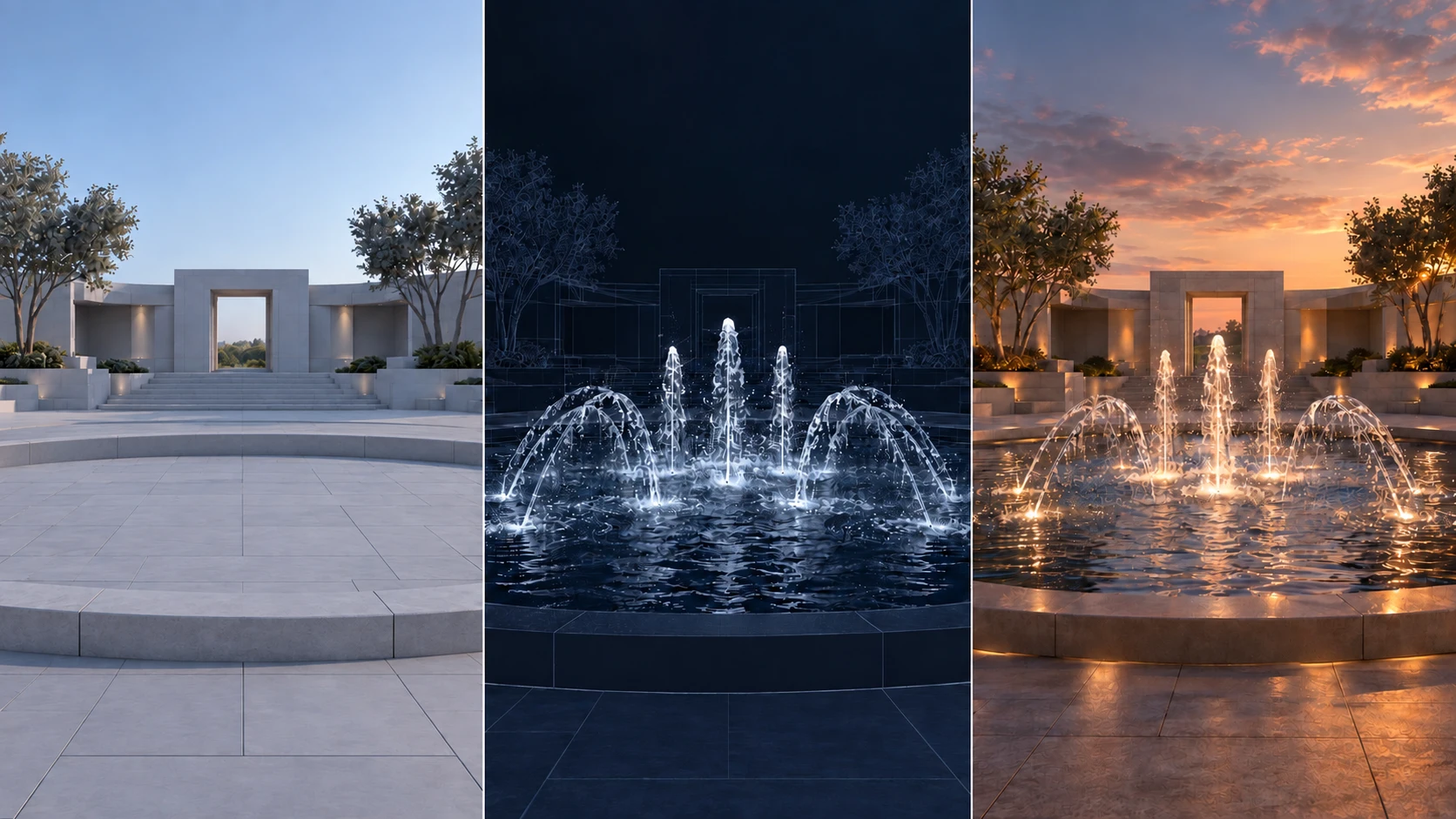
Environment
Unreal handled environments and camera motion.
Water simulation
Houdini preserved complex water behavior.
Finished visualization
Compositing brought the environment and water together.
Conceptual illustration of the hybrid workflow in a fictional scene, generated for this portfolio; not an original software screenshot.
From visualization to decision
The finished visualization becomes the shared material for executive review and the next project decision.
Executive review
Turn an unbuilt experience into something leaders can see and evaluate.
Decision
Move from visualization to action with greater confidence.
The hybrid approach became WET’s standard visualization workflow after I left.
How I created organizational capability
Four interventions that changed how WET communicated the future.
The work was not a collection of technology demos. It raised the team’s visual standard, introduced durable real-time and immersive workflows, strengthened major investment proposals, and gave designers new ways to evaluate experiences before they physically existed.
Raising the Standard
I raised the quality bar, mentored a young team, and introduced established VFX practices so the work communicated design intent with greater clarity and confidence.
- Mentoring and hands-on art direction
- Nuke, Mari, and Substance adoption
- Common VFX standards and pipelines
Looking Beyond the Screen
I led practical experiments in VR, AR, and 360 media. I always asked whether the technology improved the experience rather than distracting from it.
- Early Vive access through Valve
- Unity AR experiments around features
- 360 capture and immersive presentation
Visualizing the Impossible
Photorealism was not always the right answer. I explored non-photorealistic rendering that preserved architectural context while allowing water, light, and choreography to remain the visual focus.
Technology Translator
I became a go-to resource for emerging technology because I could connect technical possibility to design and business needs.
- Transparent LED systems
- Light and illumination models
- Real-time graphics and new hardware
- Research translated into usable decisions
Featured success
Bellagio 360° Capture and VR Presentation
The hybrid workflow was one part of a broader shift: let teams and leaders experience the design, then choose the medium that best supported the decision.
The Bellagio water show had not received a major technical upgrade in decades. To help MGM’s board understand what was possible, we needed to make the future feel present.
I helped capture Tiësto at the Bellagio in immersive 360. That included swimming into the lake to position cameras. The resulting experience was presented on Samsung VR headsets as part of the upgrade proposal.
Swam into the lake to position cameras close to the performance.
Created an immersive record of Tiësto at the Bellagio.
Presented the experience using Samsung VR headsets.
Immersive communication helped sell the scale and value of the proposal.
Knowing what not to build
Technology should enhance the experience, not compete with it.
I explored Unity-based AR experiences for use in and around WET features. The central design constraint was deliberate: a phone should not pull attention away from the physical experience.
No commercial product emerged, but the experiments sharpened an important principle that has stayed with me: sometimes the best product decision is deciding not to build the product.
Lasting organizational impact
Capabilities that continued after I moved on.
The hybrid Unreal, Houdini, and compositing workflow became WET’s standard after I left. Alongside mentoring and stronger VFX practices, it gave the team a repeatable way to communicate complex designs.
The origin
A childhood memory became an unexpected career turn.
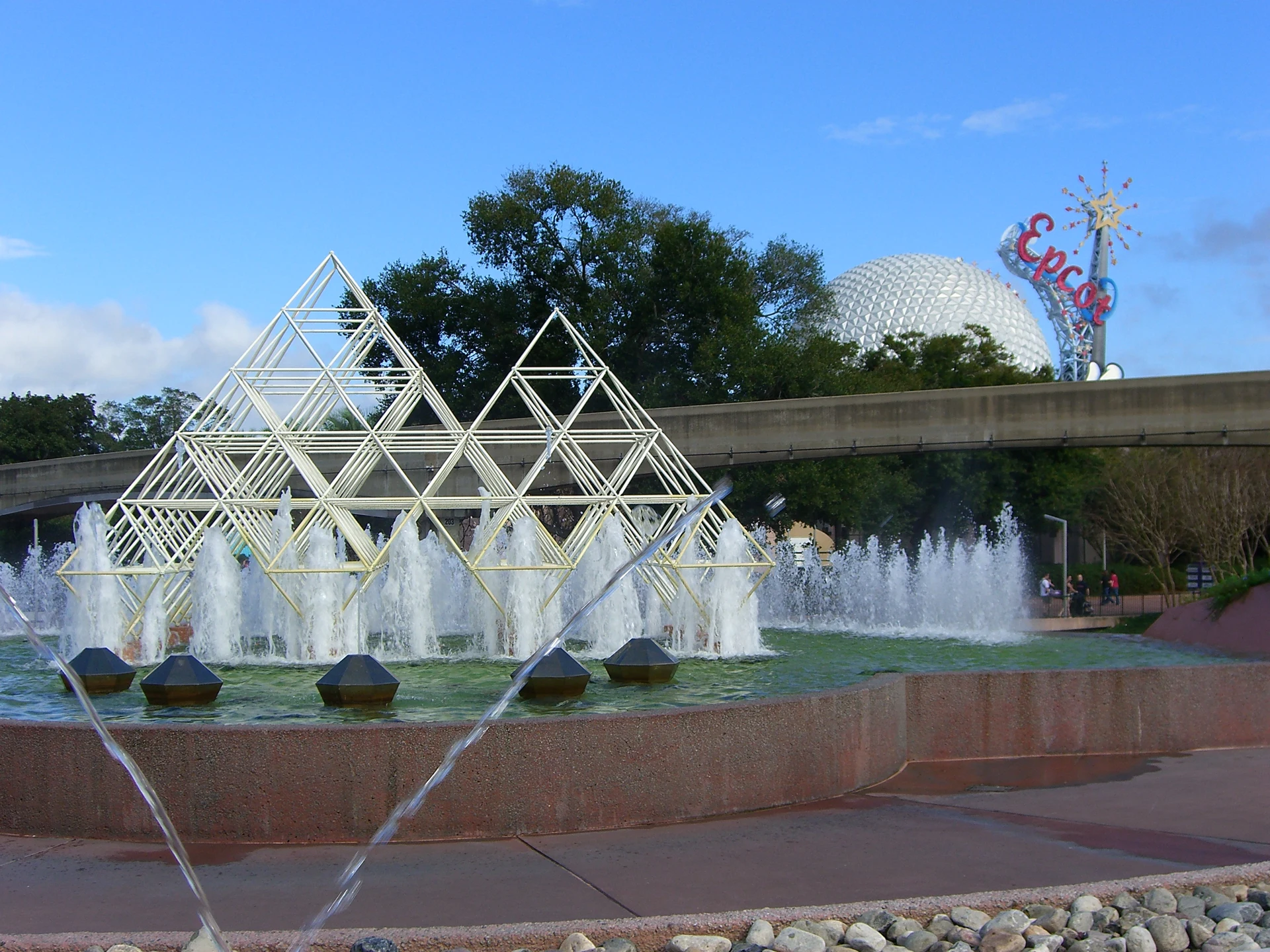
While at DreamWorks, I watched WET present work that blended engineering, architecture, and storytelling unlike anything else. I was surprised to learn the company was in Los Angeles. I also learned that it had been founded by the designer behind an EPCOT water feature I loved as a child.
Years later, after returning to Los Angeles, I interviewed for a lighting role. The assignment was to bring experience to a talented but early-career visualization team. I agreed, then argued that the larger opportunity was VR, AR, and immersive media. WET hired me. After seeing how broadly I contributed, the company gave me the title Digital Futurist .
EPCOT jumping fountains · Photo: Reywas92 · CC BY-SA 3.0 · cropped for this page.
What I carried forward
Technology should make an experience easier to understand, not become the experience itself.
At Bellagio, immersion helped communicate a proposal. In the AR experiments, protecting attention on the physical experience mattered more than shipping a phone feature. Both decisions started with the audience.